
Introduction Setting up a business in Dubai is a dream for many entrepreneurs, but the…

Free Zone vs Mainland Dubai: Key Differences, Setup Cost & Rules
One of the first big decisions you face when starting a new company in Dubai is where it should be licensed. The choice between free zone vs mainland Dubai affects who you can sell to, where you can work from, how your costs add up and how your business is regulated.
Neither option is right for everyone. This guide explains how each setup works, where they differ, what drives the cost, and which questions to answer before you apply.
Understanding Free Zone and Mainland Business Setups in Dubai
A mainland company is licensed by the economic department of the emirate where it operates. Under the UAE’s official process, you choose a business activity, select a legal form, register a trade name, obtain initial approval, and secure premises before the licence is issued.
A free zone company is set up in one of the UAE’s designated economic zones and licensed by that zone’s own authority. Each free zone has its own regulations, permitted activities and company types, and not every zone registers every type of company.
Difference Between Free Zone and Mainland: At a Glance
When comparing free zone vs mainland Dubai, the biggest practical differences come down to market access, regulator and premises. The table below summarises the main points.
| Area | Mainland | Free zone |
| Licensing authority | The emirate’s economic department | The individual free zone authority |
| Selling in the UAE market | Can trade within the UAE under its licence | Direct sales in the mainland are generally not permitted without the required licences or approvals |
| Foreign ownership | 100% foreign ownership allowed for most activities, with some exceptions | Companies can be fully foreign-owned |
| Premises | A physical address is required; Dubai rental agreements must be registered with Ejari | Depends on the free zone’s own rules |
| Rules and activities | Set by the emirate and relevant federal authorities | Set by each free zone, so they vary from zone to zone |
Business Activities, Licensing and Market Access
Your business activity is the starting point for both routes. It determines the legal form, the type of licence, and whether any extra approvals are needed from other government bodies.
Market access is often the deciding factor. According to the UAE government portal, a free zone company is treated as outside the mainland’s jurisdiction. To sell locally, it generally needs to work through a licensed mainland distributor, set up a mainland branch or company, or obtain the required mainland licences or approvals. Goods brought from a free zone into the mainland market also become subject to customs duty.
If most of your customers will be UAE businesses or consumers, look at Dubai mainland company formation closely. If you mainly trade internationally, or your activity suits a particular zone, UAE free zone company formation may be worth comparing.
Mainland vs Free Zone License Cost Dubai: What Affects the Cost?
There is no single answer to the mainland vs free zone license cost Dubai question, because the total depends on choices you make and the authority you apply to. Advertised starting prices rarely tell the full story, so ask for a breakdown of what is included and what is not.
The main cost factors are:
- Licensing authority. Each free zone and each emirate sets its own fees and packages.
- Business activity. Some activities need additional approvals from other authorities.
- Legal form. The structure you choose affects documents, agreements and requirements.
- Premises. Office type, size and location affect rent, and mainland premises in Dubai need a registered Ejari contract.
- Visas. The number of visas you need, and any related establishment or immigration charges, add to the total.
- Renewals. Licences are renewed, so budget for ongoing costs as well as the initial setup.
Compare quotes on the same basis, covering the licence, premises, visas and renewals, before deciding which route is more economical for you.
Ownership, Visas, Office Requirements and Other Considerations
Ownership
Since 2021, UAE law has allowed 100% foreign ownership of most mainland companies. Some activities with strategic impact can still carry ownership restrictions or extra licensing conditions. Free zone companies can be fully foreign-owned, subject to each zone’s rules.
Visas and Premises
Visa eligibility is not the same for every licence. It can depend on the licensing authority, the licence type and the premises you lease, so confirm your entitlement with the relevant authority before you commit. Every UAE business needs a physical address, and premises must meet local requirements.
Banking
A trade licence does not guarantee a bank account. Banks apply their own due diligence, documentation and approval procedures, whichever jurisdiction you choose. Our guide to opening a corporate bank account in Dubai explains what to prepare.
Corporate Tax and Compliance for Free Zone and Mainland Companies
Corporate tax applies to businesses on the mainland and in free zones. The standard rates are 0% on taxable income up to AED 375,000 and 9% on taxable income above that.
Free zone companies are not automatically taxed at 0%. According to the UAE Federal Tax Authority (FTA), a Qualifying Free Zone Person pays 0% on qualifying income and 9% on taxable income that does not meet the qualifying income definition. To qualify, a company must meet the conditions set out in the law and FTA guidance. Free zone companies are also covered by the FTA’s corporate tax registration timelines, so registration is required even where a 0% rate may apply.
Because eligibility depends on your activities and income, it helps to get advice early. Professional corporate tax services UAE can help with registration, returns and planning.
How to Choose the Right Business Setup
Before applying, answer these questions:
- Who will your customers be, and where are they based?
- Is your activity permitted in the free zone you are considering?
- What kind of premises do you need, and how many visas?
- What are the full setup and renewal costs, not just the starting price?
- How will corporate tax rules apply to your expected income?
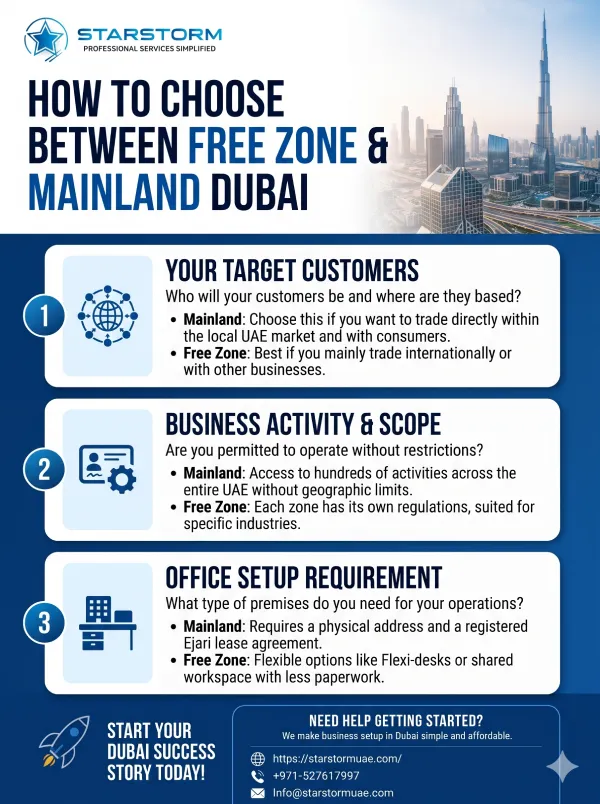
How StarStorm UAE Can Help
StarStorm UAE offers business setup services Dubai for mainland, free zone and offshore company formation, alongside corporate tax registration, return filing and consultancy. If you are weighing up your options, contact the team for a consultation based on your planned activity and customer base.
Conclusion
The free zone vs mainland Dubai decision depends on your activity, your customers, your premises and your long-term plans. Mainland suits businesses that want to trade directly across the UAE market, while free zones can suit companies focused on international trade or a specific zone. Compare full costs, confirm the rules with the licensing authority, and plan for corporate tax from day one.
Frequently Asked Questions
1. Free zone vs mainland Dubai: which is better for a new business?
Neither is better for every business. Mainland suits companies that want to sell directly within the UAE, while free zones can suit international trading or zone-specific activities. Your activity, customers, premises and budget should guide the decision.
2. What is the main difference between free zone and mainland companies?
The biggest practical difference is market access and who you can sell to. Mainland companies can trade within the UAE under their licence, while free zone companies generally need a distributor, branch or approvals to sell directly in the mainland.
3. How do I compare mainland vs free zone license cost Dubai options?
Ask each authority or provider for a full breakdown covering the licence, premises, visas, approvals and renewals. Starting prices often exclude some of these costs, so compare complete quotes on the same basis before choosing.
4. Do free zone companies pay corporate tax in the UAE?
They can. A Qualifying Free Zone Person pays 0% on qualifying income and 9% on other taxable income. Companies must meet specific conditions to qualify, and free zone companies still need to register for corporate tax.
5. Do mainland and free zone companies both need office premises?
Yes. Every UAE business needs a physical address. In Dubai, mainland rental agreements must be registered with Ejari, while free zone premises rules depend on the zone, which is another practical difference between free zone and mainland setups.
Related Posts