IFZA license cost in UAE starts from AED 12,900 for a zero-visa package in 2026.…

What Do You Need For Bank Account Opening in Dubai 2026: Complete Guide for Residents and Non-Residents
To open a bank account in Dubai, you’ll need a valid passport, proof of address, and for residents, an Emirates ID and residence visa; for non-residents, six months of bank statements and a higher minimum deposit. UAE residents can now complete UAE bank account setup fully online through digital banks like Wio or Mashreq Neo in as little as 24 hours, while non-residents typically need an in-person branch visit.
Opening a bank account in Dubai is one of the first financial steps you need to take when you arrive in the UAE, whether you’re relocating for work, starting a business, or managing international investments. Dubai’s banking system is among the most advanced in the Middle East, offering secure digital banking services, multi-currency accounts, and seamless mobile banking apps that let you open an account online in minutes. This complete 2026 guide walks you through everything you need to know: eligibility requirements, documents you need to provide, the types of bank accounts available, and how to choose the right banking services for your lifestyle.
Why Open a Bank Account in Dubai?
Dubai is a global financial hub with world-class banking convenience, zero personal income tax, and a currency pegged to the USD for stability. Whether you’re a salaried employee, an entrepreneur, or an investor, having a local bank account offers you:
- Secure and stable banking – UAE banks are among the safest globally, with Fitch ratings at AA- with stable outlooks
- Digital banking services – instant transactions, mobile banking apps, and account online access 24/7
- Multi-currency support – hold AED, USD, EUR, and GBP in a single account
- International transfers – send money abroad with no foreign exchange control
- Exclusive benefits – premium accounts offer cashback, reward points, travel insurance, and airport lounge access
- Tax efficiency – zero personal income tax on savings and salary deposits
For residents, opening a Bank account in Dubai is essential for receiving your salary, paying bills, and managing everyday banking needs. For non-residents, it provides a stable platform for international finance, investment opportunities, and asset protection.
Quick-Start Banking Checklist for New UAE Residents
If you just landed in the UAE, here’s the fastest path to a working bank account:
- Get your Emirates ID application receipt – most digital banks accept this even before the physical card arrives.
- Pick a digital-first bank if you want speed – Wio Bank and Mashreq Neo offer zero-balance, fully app-based onboarding for residents.
- Have your employment contract or offer letter ready – many banks accept this in place of a salary certificate for brand-new employees.
- Confirm your proof-of-address document – a tenancy contract, or a letter from your employer, both work.
- Decide current vs. savings upfront – if you’re being paid a salary, a current account is the standard first step; savings accounts suit those not transacting frequently.
This checklist covers the essentials – the full documents and step-by-step process are detailed below.
Who Can Open a Bank Account in the UAE?
Residents (Visa Holders)
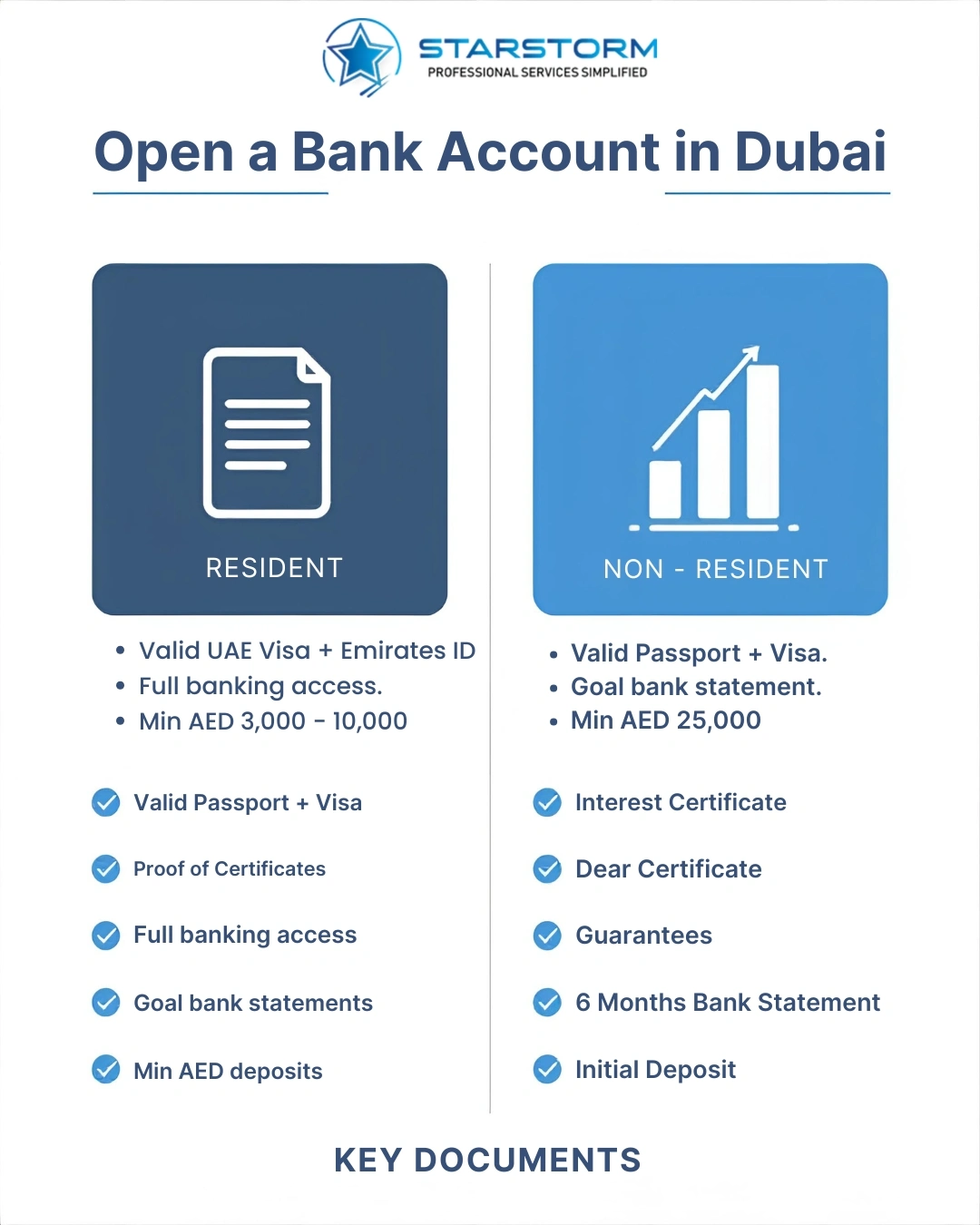
Foreigners with a valid UAE residence visa can open both current and savings accounts with full banking services – including cheque books, debit cards, credit cards, overdraft facilities, and loans. The process is fast and can often be completed digitally through a mobile banking app.
Eligibility for UAE residents:
- Must be at least 21 years old (UAE Central Bank regulation)
- 18-year-olds employed by government or semi-government entities can open accounts
- Must hold a valid residence visa (employment, investor, family, or student visa)
- Must have an Emirates ID
Non-Residents
Non-residents can open a bank account in the UAE, but options are more limited. You can typically open a savings account or a fixed deposit account, but current accounts with cheque books are usually not available.
Eligibility for non-residents:
- Must have a valid passport (minimum six months validity)
- Must provide personal bank statements from the last 6 months
- Most banks require a higher minimum balance – often starting from AED 25,000 or more
- In-person visit to the UAE is usually required (though some banks offer preliminary approval remotely)
Non-resident accounts are ideal for high-net-worth individuals looking to invest, hold foreign currency, or use the UAE as a financial base for asset protection.
What Types of Bank Accounts Are Available in Dubai?
UAE banks offer three main types of personal accounts:
1. Current Account
A current account (also called a checking account) is designed for frequent transactions. It allows unlimited deposits and withdrawals, comes with a cheque book, and supports high transaction volumes.
Best for: Salaried employees, business owners, and anyone managing everyday banking with frequent payments
Key features:
- Unlimited transactions per month
- Cheque book facility
- Overdraft options (subject to eligibility)
- Debit card included
- Online and mobile banking access
Note: Current accounts typically require a minimum balance of AED 3,000 to AED 10,000 depending on the bank.
2. Savings Account
A savings account is designed to help you save and earn interest on your deposit. Transactions are more limited compared to current accounts, but you benefit from interest earnings (if offered by the bank).
Best for: Building long-term savings, emergency funds, or goal-based financial planning
Key features:
- Interest earnings on your balance (rates vary by bank and currency)
- Limited monthly withdrawals (typically 3 to 5 free withdrawals per month)
- No cheque book
- Debit card included
- Mobile banking app access
Note: Savings accounts often require a minimum balance of AED 3,000 to AED 5,000. Non-residents are usually limited to savings accounts only.
3. Fixed Deposit Account
A fixed deposit account allows you to lock in a sum of money for a set period (typically 3 months to 5 years) in exchange for a guaranteed interest rate. You cannot withdraw funds during the term without penalties.
Best for: Long-term savings with guaranteed returns, preserving capital, or meeting specific financial goals
Key features:
- Higher interest rates compared to savings accounts
- Fixed term (3 months, 6 months, 1 year, 3 years, 5 years)
- No withdrawals during the term (or penalties apply)
- Available in AED, USD, EUR, and other currencies
Note: Minimum deposit typically starts from AED 10,000 but varies by bank and term.
Zero-Balance and Digital-Only Bank Accounts in the UAE
Yes, several UAE banks let you open and maintain an account with AED 0 minimum balance. This has become one of the most-searched banking topics among new residents and budget-conscious account holders.
- Wio Bank – fully digital, AED 0 minimum balance, instant account opening via the mobile app.
- Mashreq Neo – 100% digital onboarding, AED 0 minimum balance, strong for residents who want to skip branch visits entirely.
- Traditional banks (Emirates NBD, ADCB, FAB, RAKBANK) generally still require AED 3,000+ minimum balance, so they aren’t zero-balance options.
Who zero-balance accounts suit best: new residents still settling in, students, first jobbers, or anyone who wants to avoid minimum-balance fees while they build up savings. The trade-off is typically fewer premium features (like cheque books or higher overdraft limits) compared to standard current accounts.
What Documents Do You Need to Open a Bank Account in Dubai?
For UAE Residents (With Residence Visa)
Most digital banks allow you to open an account instantly using just your Emirates ID and UAE Pass. However, traditional banks typically require the following:
- Valid passport with UAE residence visa page
- Emirates ID (original and copy)
- Salary certificate from your employer or labor contract (if employed)
- Proof of address – utility bill, tenancy contract, or letter from your employer confirming your residence
- Personal bank statement from the last 3 to 6 months (if applicable, especially if transferring funds)
- Initial deposit – some banks require an opening deposit to activate the account (typically AED 1,000 to AED 5,000)
For Non-Residents (Without UAE Visa)
Non-residents need to provide additional documentation to meet Anti-Money Laundering (AML) and Know Your Customer (KYC) compliance requirements:
- Valid passport (minimum six months validity)
- Personal bank statements from the last 6 months from your home country bank
- Proof of address from your home country (utility bill, government letter, or lease agreement)
- Reference letter from your current bank (some banks require this)
- Proof of source of funds – salary slips, business income statements, or investment documents
- Minimum deposit – often AED 25,000 to AED 100,000 depending on the bank
Important: Non-residents usually cannot open a bank account online and must visit a branch in person. However, some banks offer preliminary approval remotely – consult with a banking advisor before traveling.
Step-by-Step: How to Open a Bank Account in Dubai in 2026
Step 1 – Choose the Right Bank
Select a bank that suits your needs. Consider factors like:
- Minimum balance requirements
- Monthly fees (if any)
- Digital banking app quality
- Multi-currency account options
- Credit card and loan offerings
- Branch and ATM network
Top UAE banks for expats in 2026:
| Bank | Best For | Minimum Balance | Digital Banking |
| Emirates NBD | Full-service banking, expat-friendly | AED 3,000 | Excellent app |
| Mashreq Neo | 100% digital, zero-balance option | AED 0 | Best digital experience |
| Wio Bank | Digital-first, instant account opening | AED 0 | Fast mobile onboarding |
| ADCB | Premium banking, cashback offers | AED 3,000 | Strong mobile app |
| FAB (First Abu Dhabi Bank) | Largest UAE bank, multi-currency | AED 3,000 | Comprehensive services |
| HSBC UAE | Global banking, HSBC Premier tiers | AED 10,000 (Premier) | International network |
| RAKBANK | Low minimum balance, SME-friendly | AED 3,000 | Good online banking |
| Dubai Islamic Bank (DIB) | Shariah-compliant banking | AED 3,000 | Islamic finance options |
Step 2 – Decide on Account Type
Choose between a current account (for frequent transactions), savings account (for interest earnings and long-term goals), or fixed deposit (for guaranteed returns over a set term).
Tip: If you’re salaried, start with a current account. If you’re saving for a goal or rarely make withdrawals, choose a savings account.
Step 3 – Prepare Your Documents
Gather all required documents based on your residency status. Make sure your passport and Emirates ID are valid, and that you have certified copies of all supporting documents.
Step 4 – Apply Online or Visit a Branch
For digital banks (Wio, Mashreq Neo):
- Download the mobile banking app
- Scan your Emirates ID
- Take a selfie for biometric verification
- Upload supporting documents (salary certificate, proof of address)
- The bank conducts KYC checks (usually takes 24 to 48 hours)
- Once approved, your debit card is delivered to your address within 3 to 5 working days
For traditional banks (Emirates NBD, ADCB, FAB, HSBC):
- Visit the nearest branch with your documents
- Fill out the account application form
- Submit your documents and initial deposit
- The bank processes your application (typically 1 to 3 working days)
- Your debit card and account details are provided once approved
For non-residents:
- Contact the bank in advance to confirm their non-resident account offerings
- Schedule an in-person appointment (most banks require this)
- Bring all required documents including 6-month bank statements and proof of funds
- Be prepared for a longer approval process (1 to 2 weeks on average)
Step 5 – Activate Your Account and Set Up Digital Banking
Once your account is approved:
- Activate your debit card at an ATM or via the mobile banking app
- Set up online and mobile banking for convenient access
- Link your account to payment apps like Apple Pay, Google Pay, or Samsung Pay
- Set up standing instructions for bill payments or recurring transfers
- Explore premium account features like credit card applications, investment products, or fixed deposit options
How Long Does It Take to Open a Bank Account in Dubai?
- Digital banks (residents with Emirates ID): Instant to 48 hours
- Traditional banks (residents): 1 to 3 working days
- Non-residents: 1 to 2 weeks (due to compliance checks)
Thanks to digital banking innovation in 2026, UAE residents can now open a personal account in minutes using just their Emirates ID and a mobile banking app – no paperwork, no branch visit required.
Common Challenges and How to Avoid Them
Challenge 1 – Account Application Rejected
Why it happens: Incomplete documents, unclear source of funds, or high-risk profile
Solution:
- Provide complete, certified copies of all documents upfront
- Include a clear explanation of your source of income or funds
- Avoid applying to multiple banks simultaneously – this raises red flags
Challenge 2 – Long Processing Times for Non-Residents
Why it happens: Banks conduct extensive AML/KYC checks for non-residents
Solution:
- Work with a banking consultant who can facilitate preliminary bank approval
- Choose banks with dedicated non-resident account packages (HSBC UAE, Emirates NBD)
- Be patient – the process can take 1 to 2 weeks
Challenge 3 – High Minimum Balance Requirements
Why it happens: Premium accounts and non-resident accounts require higher balances
Solution:
- If you’re a resident, choose a digital bank with zero-balance options (Wio, Mashreq Neo)
- If you’re a non-resident, compare multiple banks – minimum balance requirements vary significantly
Challenge 4 – Difficulty Opening Account Online as Non-Resident
Why it happens: UAE banking regulations require in-person verification for non-residents
Solution:
- Contact the bank in advance to request preliminary approval
- Schedule your UAE visit to coincide with the account opening appointment
- Consider obtaining a UAE residence visa first – this unlocks full banking access
How We Can Help You Open a Bank Account in Dubai
Navigating UAE banking regulations, gathering the right documentation, and choosing the best bank for your needs can be overwhelming – especially if you’re new to the country. Starstorm UAE provides end-to-end support for both residents and non-residents looking to open a bank account in the UAE.
Here’s how we help:
- Bank Selection Guidance – We assess your profile, income level, and banking needs to recommend the best banking services for your lifestyle
- Document Preparation – We review and prepare all required documents to ensure your application is complete and compliant
- Preliminary Bank Approval – We work with UAE banks to secure preliminary approval before you visit (especially valuable for non-residents)
- Account Opening Assistance – We accompany you to the branch or guide you through the digital onboarding process step by step
- Business Bank Account Setup – If you’re opening a corporate bank account for your UAE company, we manage the entire process, including trade license verification, shareholder documentation, and compliance filings
- Ongoing Banking Support – We provide continued support for credit card applications, investment accounts, and premium account upgrades
With Starstorm UAE, you eliminate the guesswork, avoid rejections, and get your UAE bank account opened quickly and correctly.
Conclusion
Opening a bank account in Dubai in 2026 is faster, more convenient, and more accessible than ever before, especially for UAE residents who can now complete the entire process digitally in minutes. Whether you’re a salaried expat looking for everyday banking, an entrepreneur setting up a business, or a non-resident seeking a secure international finance platform, Dubai’s banking system offers world-class security, digital banking services, and exclusive benefits that make it one of the best places to bank globally.
From choosing the right account type to preparing your documents and completing the digital onboarding, this guide has covered every step you need to take. With the right preparation and professional support from Starstorm UAE when needed, you can have your UAE bank account up and running quickly, giving you the financial foundation to live, work, and invest in one of the world’s most dynamic cities.
Frequently Asked Questions
Can I open a bank account in the UAE without a residence visa?
Yes, non-residents can open a savings account or fixed deposit account in the UAE, but not a current account. You'll need to visit the UAE in person, provide 6 months of bank statements, and meet the minimum balance requirement (typically AED 25,000 or higher).
What documents do I need to open a bank account in Dubai?
UAE residents need: passport with residence visa, Emirates ID, salary certificate, and proof of address. Non-residents need: passport, 6-month personal bank statements, proof of address from home country, and proof of source of funds.
How long does it take to open a bank account in Dubai?
For UAE residents using digital banks, it takes as little as 24 to 48 hours. For traditional banks, it typically takes 1 to 3 working days. For non-residents, the process can take 1 to 2 weeks due to compliance checks.
Can I open a UAE bank account online?
Yes, if you’re a UAE resident with a valid Emirates ID. Digital banks like Wio and Mashreq Neo offer fully online onboarding. Non-residents typically cannot open accounts online and must visit a branch in person.
What is the minimum balance required for a bank account in Dubai?
It varies by bank and account type. Digital banks like Wio offer zero-balance accounts. Traditional current and savings accounts require AED 3,000 to AED 10,000. Non-resident accounts typically require AED 25,000 to AED 100,000.
add_action(‘wp_head’, function() {
?>
Related Posts