
IFZA license cost in UAE starts from AED 12,900 for a zero-visa package in 2026.…

How to Get a Tax Residency Certificate in UAE for an Individual 2026? Complete Guide
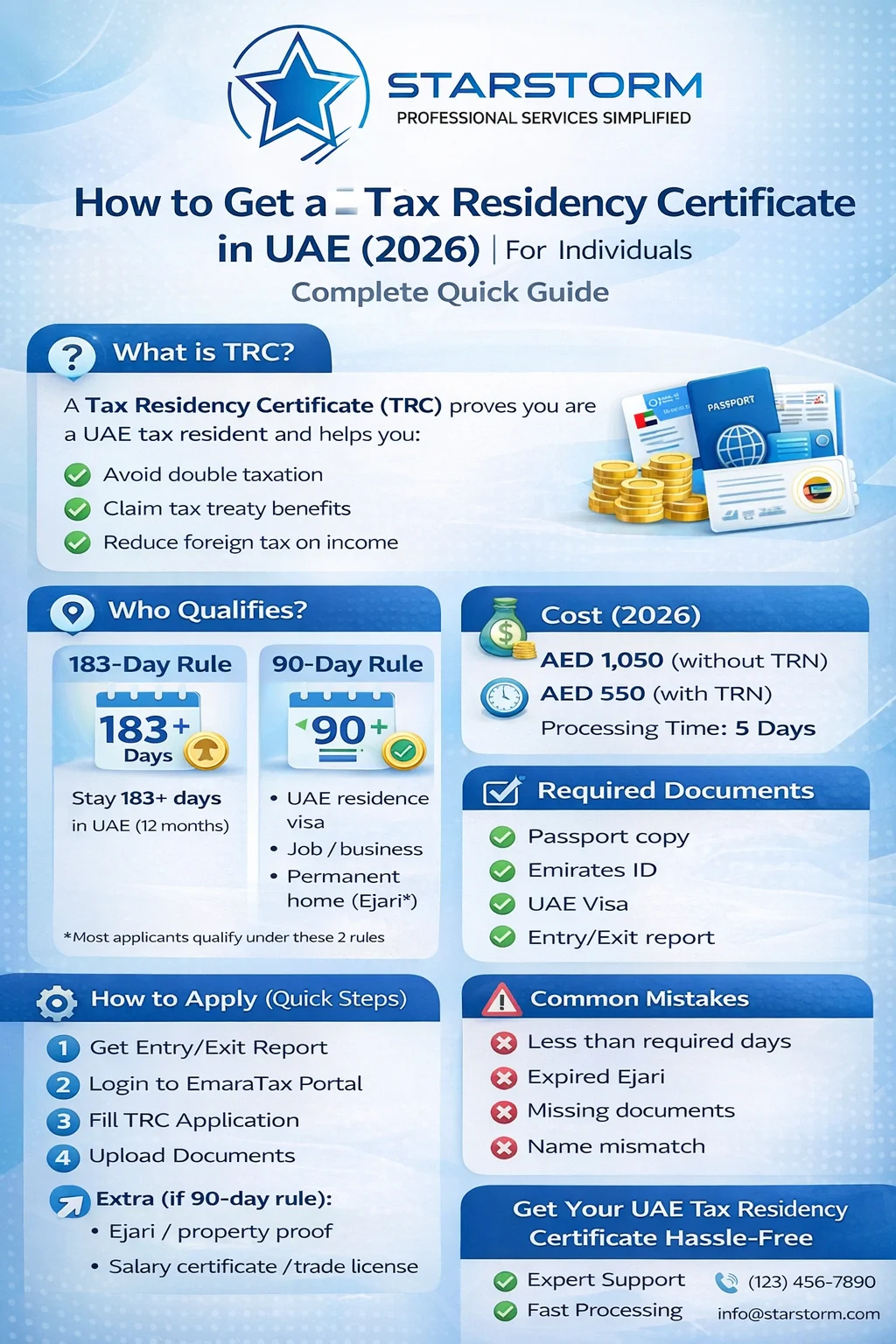
To get a tax residency certificate in UAE for an individual, you must meet either the 183-day physical presence rule or the 90-day rule with qualifying ties (residence, employment, or business). Apply through the Federal Tax Authority (FTA) EmaraTax portal, submit required documents (Emirates ID, entry/exit report), and pay AED 1,050. Processing takes 5 business days. The certificate is valid for a 12-month period.
What is a Tax Residency Certificate in the UAE for an individual?
A tax residency certificate (TRC) in UAE for individual is an official document issued by the Federal Tax Authority (FTA) that proves you are a UAE tax resident. This certificate enables you to claim benefits under double taxation avoidance agreements (DTAs) signed by the UAE with 140+ countries, preventing you from paying tax twice on the same income.
The Federal Tax Authority (FTA) is the UAE government body responsible for administering federal tax laws, issuing tax residency certificates, and managing corporate tax registration through the EmaraTax portal at tax.gov.ae.
Why You Need a TRC:
- Avoid double taxation on foreign income
- Claim withholding tax reductions under tax treaties
- Prove UAE tax residency to foreign tax authorities
- Meet requirements for international banking and investments
- Reduce dividend/interest tax rates under DTAs
Without a tax residency certificate, your home country may tax your worldwide income. For high earners, this could mean paying tens or hundreds of thousands of dirhams in unexpected tax liability.
Who Qualifies as a UAE Tax Resident?
Under Cabinet Decision No. 85 of 2022 and Ministerial Decision No. 27 of 2023, individuals become UAE tax residents by meeting any one of three tests:
Test 1: 183-Day Rule (Most Common)
You were physically present in the UAE for 183 days or more within a 12-month period.
Key Details:
- Days do not need to be consecutive
- Part days count as full days
- Entry and exit days both count
- Proven via entry and exit report from the Federal Authority of Identity and Citizenship
Example: An expat living in Dubai from January 1 to December 31, 2026, spending 200 days physically present in the UAE, qualifies under this rule.
Test 2: 90-Day Rule (With Qualifying Ties)
You spent 90 days or more in UAE within 12 months AND meet one of these conditions:
- You are a UAE national or GCC national
- You hold a valid UAE residence visa
- You have a permanent place of residence in UAE (owned or rented property with valid Ejari)
- You are employed in UAE (with salary certificate)
- You own a business in UAE (with valid trade license)
Example: A GCC national spending 120 days in UAE with a valid employment contract qualifies under the 90-day rule.
Test 3: Centre of Vital Interests (Rare)
The UAE is your primary or usual place of residence and the centre of your financial and personal interests, even if you spend less than 90 days physically present in the UAE.
FTA Looks At:
- Where your family lives permanently
- Location of your primary income source
- Where your main assets are located
- Your habitual residence pattern
Note: This test is rarely used and requires substantial documentation proving UAE is your life’s primary center.
Tax Residency Certificate Cost in Dubai 2026
| Fee Component | Individual Cost (AED) |
| Application Submission | 50 |
| Certificate Issuance (with Corporate Tax TRN) | 500 |
| Certificate Issuance (without TRN) | 1,000 |
| Hard Copy (optional) | 250 |
| Total (most individuals without TRN) | 1,050 |
Source: Federal Tax Authority Fee Schedule, effective January 1, 2026
Note: If you have registered for UAE corporate tax and hold a Tax Registration Number (TRN), your total cost is AED 550 instead of AED 1,050.
Required Documents for TRC Application
For All Individuals:
Valid passport (copy with visa page)
Emirates ID (front and back)
UAE residence visa (valid throughout the 12-month period)
Entry and exit report from Federal Authority of Identity and Citizenship (FAIC) – proves 183 or 90 days presence
Additional Documents (Depending on Test):
If applying under 90-day rule:
- Ejari or Tawtheeq (registered tenancy contract) OR property ownership deed
- Salary certificate (if employed) OR trade license (if self-employed/business owner)
- Bank statements showing UAE-based financial activity (3-6 months)
If applying for DTA-purpose TRC:
- Proof of source of income (salary slips, business income statements)
- Some countries may require additional country-specific forms
Important: According to FTA’s October 2024 guidance, bank statements are NOT required for DTA-purpose TRCs unless specifically requested.
How to Apply for a Tax Residency Certificate in the UAE: Step-by-Step Process
Step 1 – Obtain Entry/Exit Report
Visit the Federal Authority of Identity and Citizenship portal or app:
- Request official entry and exit report covering your 12-month period
- Confirm it shows 183+ days (or 90+ days with ties)
- Cost: Free via FAIC digital services
Step 2 – Register on EmaraTax Portal
Go to tax.gov.ae and create an account:
- Use your UAE mobile number and email
- Verify identity via Emirates ID
- Set up login credentials
Step 3 – Start TRC Application
Log in to EmaraTax:
- Navigate to “Other Services”
- Select “Tax Residency Certificate”
- Choose application type:
- For DTA purposes (select specific country)
- For other purposes (domestic use)
Step 4 – Enter Personal Details
Complete the form:
- Full name (as per passport)
- Passport number and nationality
- Emirates ID number
- UAE address (must match Ejari)
- Contact information
If you have Corporate Tax TRN: Enter it to reduce fees from AED 1,050 to AED 550.
Step 5 – Select 12-Month Period
Choose the calendar year (January 1 – December 31) you’re applying for.
Important: You cannot apply for future periods. Only current or past 12-month periods are eligible.
Step 6 – Upload Documents
Attach all required documents:
- Passport copy
- Emirates ID (both sides)
- Entry/exit report from FAIC
- Ejari/Tawtheeq (if using 90-day rule)
- Salary certificate or trade license (if applicable)
File Format: PDF preferred, max 5MB per document
Step 7 – Pay Fees
Complete payment online:
- AED 50 (submission fee)
- AED 1,000 (issuance fee for individuals without TRN)
- AED 250 (optional hard copy)
Payment Methods: Credit/debit card via EmaraTax portal
Step 8 – Submit and Track
Submit your application. You’ll receive:
- Application reference number
- Email confirmation
- Ability to track status on EmaraTax portal
Processing Time: 5 business days for digital certificate (additional 5 days for hard copy)
Step 9 – Download Certificate
Once approved, download your tax residency certificate directly from the EmaraTax portal.
Certificate Includes:
- Your name and passport number
- Tax residency status confirmation
- Valid 12-month period covered
- FTA official seal and signature
Common Rejection Reasons (And How to Avoid Them)
1. Insufficient Physical Presence
Problem: Entry/exit report shows only 175 days (short of 183).
Solution: Double-check day counts. Entry and exit days both count as full days.
2. Expired Ejari or Tawtheeq
Problem: Tenancy contract expired during the 12-month period.
Solution: Ensure your Ejari is valid and registered for the entire period you’re claiming.
3. Name Spelling Inconsistencies
Problem: Passport says “Mohammed,” Emirates ID says “Mohamed.”
Solution: Use exact spelling from your passport across all documents.
4. Missing 90-Day Supporting Documents
Problem: Claimed 90-day rule but didn’t provide employment contract or trade license.
Solution: Submit all required tie-breaker documents (Ejari + salary certificate/trade license).
Double Taxation Avoidance: How TRC Helps
The UAE has signed double taxation avoidance agreements (DTAs) with 140+ countries including UK, USA, Canada, India, France, Germany, China, and more.
How It Works:
Without TRC:
- Your home country taxes your global income at their rates (e.g., 30-45%)
- Foreign banks withhold 20-30% on dividends/interest
With TRC:
- UAE DTA reduces withholding tax rates (often to 5-10%)
- Your home country recognizes UAE tax residency
- You claim tax treaty benefits
Real Example: A UK expat earning dividend income from UK investments. Without TRC, UK withholds 15% tax. With UAE TRC under UK-UAE tax treaty, withholding drops to 5%, saving thousands of pounds annually.
TRC Validity and Renewal
Validity Period: Tax residency certificate is valid for one 12-month period (the calendar year you applied for).
Renewal Required: Yes, annually. You must reapply each year with updated documents proving continued UAE tax residency.
Renewal Timeline: Apply during or after the 12-month period you’re claiming (not before).
Example: For 2026 tax residency, apply anytime from January 1, 2026 onwards (once you’ve met the 183/90-day requirement).
How We Can Help to Get a Tax Residency Certificate in UAE
Applying for a tax residency certificate in UAE requires precise documentation, accurate day counting, and understanding complex tax treaty rules. Starstorm UAE provides comprehensive TRC application support for individuals.
Our Services:
- Eligibility Assessment – Determine if you qualify under 183-day, 90-day, or vital interests test
- Day Count Verification – Review entry/exit reports to confirm you meet physical presence requirements
- Document Preparation – Gather, organize, and format all required documents per FTA standards
- Ejari/Tawtheeq Verification – Ensure tenancy registration is valid for the entire period
- EmaraTax Application – Complete and submit your TRC application on the Federal Tax Authority portal
- Objection Handling – Respond to FTA queries or rejection reasons
- DTA Strategy – Advise on optimal tax treaty usage for your specific situation
- Annual Renewal Management – Track renewal dates and reapply each year
With Starstorm UAE, you avoid common rejection reasons, reduce processing time, and ensure your UAE tax residency status is officially recognized.
Key Takeaways
- Tax residency certificate (TRC) proves you’re a UAE tax resident to avoid double taxation
- Federal Tax Authority (FTA) issues TRCs via EmaraTax portal (tax.gov.ae)
- Cost: AED 1,050 for individuals without Corporate Tax TRN (AED 550 with TRN)
- Eligibility: 183 days physical presence OR 90 days with ties (residence, employment, business)
- Processing time: 5 business days for digital certificate
- Required documents: Passport, Emirates ID, entry/exit report, Ejari (if 90-day rule)
- Validity: One 12-month calendar year; must renew annually
- UAE has 140+ DTAs reducing withholding tax on foreign income
- No future applications: Can only apply for current or past periods
- Entry/exit report from Federal Authority of Identity and Citizenship is mandatory
- Cabinet Decision No. 85 of 2022 governs UAE tax residency rules
- 90-day rule requires proof of permanent residence OR employment/business in UAE
Frequently Asked Questions
How much does tax residency certificate cost in UAE?
AED 1,050 total for individuals without Corporate Tax TRN (AED 50 submission + AED 1,000 issuance). With TRN: AED 550. Optional hard copy adds AED 250. Valid one year.
Can I get UAE tax residency certificate without 183 days?
Yes, under 90-day rule if you have UAE residence visa AND either permanent home (Ejari), employment (salary certificate), or business (trade license). Must prove qualifying ties to UAE.
How to apply for tax residency certificate in UAE?
Apply via FTA EmaraTax portal (tax.gov.ae). Upload passport, Emirates ID, entry/exit report from Federal Authority of Identity and Citizenship, Ejari, salary certificate. Pay AED 1,050. Processing: 5 days.
What is double taxation avoidance agreement?
Double taxation avoidance agreements (DTAs) are tax treaties signed by UAE with 140+ countries preventing same income being taxed twice. UAE TRC unlocks DTA benefits like reduced withholding tax.
Is tax residency certificate valid for one year only?
Yes, tax residency certificate is valid for one 12-month period (calendar year). Must renew annually by reapplying with updated documents proving continued UAE tax resident status each year.
Do I need bank statements for tax residency certificate?
Not for DTA-purpose TRCs per FTA October 2024 guidance. Bank statements may be requested for domestic TRCs or 90-day rule applications to prove UAE financial ties and residence.
Related Posts