
IFZA license cost in UAE starts from AED 12,900 for a zero-visa package in 2026.…

What Is a Liquidation Report in UAE? Complete Company Closure Guide 2026
A liquidation report in UAE is a mandatory audit document prepared by an approved auditor confirming a company’s final financial position before closure. It verifies all liabilities are settled, assets distributed, and NOCs obtained from banks, customs, and authorities. Required for free zone, mainland, and offshore companies, this report must be submitted to the relevant free zone authority or Ministry of Economy before license cancellation.
What Is a Liquidation Report in UAE?
A liquidation report in UAE is a formal audit document that confirms a company has settled all financial obligations, distributed remaining assets, and is ready for official closure. Under Federal Decree-Law No. 32 of 2021 on Commercial Companies, every business owner must formally cancel their license when closing a business – regardless of whether the company has debts, employees, or has ever issued an invoice.
The Ministry of Economy (MoE) oversees mainland company liquidation, while each free zone authority (DMCC, IFZA, JAFZA, Meydan, DWTC) regulates liquidation for companies registered within their jurisdiction.
Why the Liquidation Report Matters:
Your trade license remains legally active – and fees continue accruing – until formally cancelled by the licensing authority. The liquidation audit report is the primary document that triggers this cancellation process. Without it, business owners face accumulated fines, visa blocks, and complications when starting future ventures in the UAE.
What Does a Liquidation Report Include?
A complete liquidation audit report verifies and documents:
- Company liabilities – all outstanding debts to suppliers, lenders, and creditors
- Asset distribution – remaining assets distributed to shareholders proportionally
- NOCs collected – from banks, telecom providers, customs, and free zone landlords
- Bank closure confirmation – official closure letter from all banking partners
- Customs & tax clearance – verification of no pending customs or VAT obligations
- Employee settlements – end-of-service gratuity and visa cancellations completed
The report must be prepared in accordance with UAE-approved accounting standards (IFRS or UAE FRS) and submitted in the format accepted by the Ministry of Economy or relevant free zone authority.
Types of Liquidation in UAE
1. Voluntary Liquidation
Most common type. Shareholders decide to close the company voluntarily, typically due to:
- Business no longer profitable
- Strategic restructuring
- Relocating operations
- Retirement of owner
Process: Shareholders pass a resolution to wind up the company, followed by liquidator appointment and final report preparation.
2. Compulsory Liquidation
Ordered by court or regulatory authority due to:
- Insolvency
- Legal non-compliance
- Court judgment against the company
Difference: Requires a court-appointed liquidator rather than a shareholder-selected auditor.
Company Liquidation Process in UAE: Step-by-Step
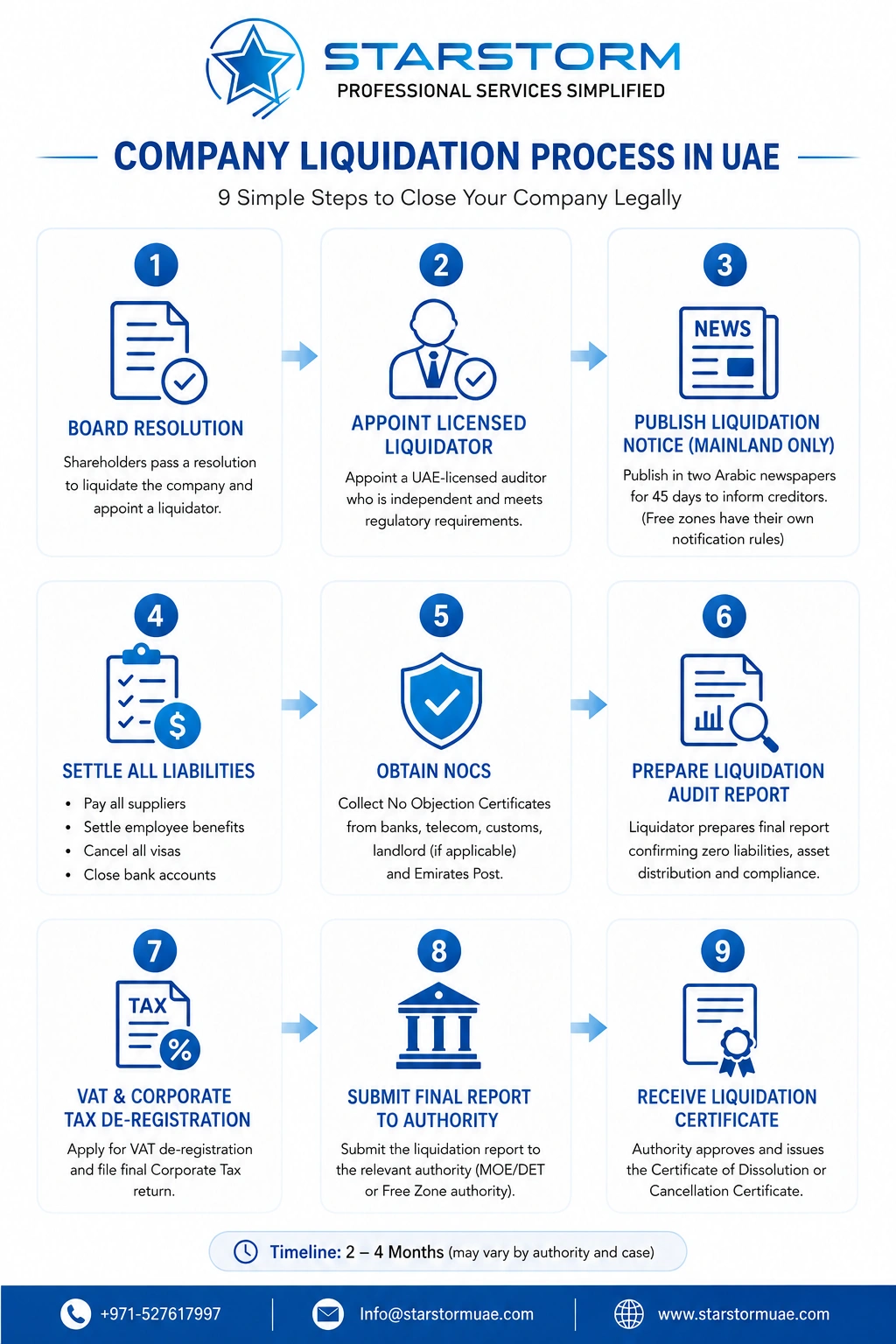
Step 1 – Board Resolution
Shareholders pass a formal resolution stating the intent to liquidate, the reason for closure, and the appointment of an official liquidator.
Step 2 – Appoint a Licensed Liquidator
The company must appoint a UAE-based auditor as liquidator. Requirements:
- Must hold a valid UAE audit license
- Cannot be the company’s current auditor
- Cannot have audited the company within the preceding 5 years
Step 3 – Publish Liquidation Notice (Mainland Only)
For mainland companies, a liquidation notice must be published in two Arabic-language newspapers for a minimum 45-day creditor notice period. This allows creditors to raise claims before final closure.
Free zone companies follow their own notification requirements, which vary by authority but generally don’t require newspaper publication.
Step 4 – Settle All Liabilities
Before the liquidator can issue a final report:
- Clear all outstanding dues to suppliers
- Settle employee end-of-service benefits
- Cancel all employee and investor visas via GDRFA/ICP
- Close all corporate bank accounts
Step 5 – Obtain Required NOCs
Collect No Objection Certificates from:
- Banks (closure confirmation letter)
- Telecom providers (Etisalat, du)
- Customs department (clearance certificate)
- Free zone landlord (if applicable)
- Emirates Post
Step 6 – Prepare the Liquidation Audit Report
The approved auditor compiles the final liquidation report, verifying:
- Zero outstanding liabilities
- Complete asset distribution
- All NOCs collected and attached
- Compliance with UAE accounting standards
For specialized assistance with this critical document, Starstorm UAE’s company liquidation report services provide complete preparation support, ensuring your report meets all authority-specific requirements without costly rejections or delays.
Step 7 – VAT and Corporate Tax De-Registration
If registered for VAT, submit de-registration application to FTA. The liquidation report supports this application and confirms compliance with UAE Corporate Tax obligations.
Timeline: FTA typically processes de-registration within 20 business days, though this extends if an audit is initiated.
Corporate Tax: File final CT return within 3 months of closure, per FTA Decision No. 6/2023.
Step 8 – Submit Final Report to Authority
Submit the completed liquidation report to:
- Mainland: Ministry of Economy or Dubai Economy and Tourism (DET)
- Free Zone: Relevant free zone authority (DMCC, IFZA, JAFZA, etc.)
Step 9 – Receive Liquidation Certificate
Upon approval, the authority issues a Certificate of Dissolution or Cancellation Certificate, officially confirming the company no longer exists.
Free Zone vs Mainland Liquidation: Key Differences
| Factor | Free Zone Companies | Mainland Companies |
| Notice Requirement | Authority-specific (no newspaper) | 2 Arabic newspapers, 45 days |
| Governing Authority | Specific free zone authority | Ministry of Economy / DET |
| Process Speed | Generally faster (30-60 days) | Longer (60-90+ days) |
| Board Resolution Format | Authority-specific format required | Standard MoE format |
| Auditor Sign-Off | Mandatory liquidation account | Mandatory audit report |
Important 2026 Update: Under Federal Decree-Law No. 20 of 2025, free zone companies (including DIFC and ADGM entities) with onshore mainland branches are now subject to Commercial Companies Law. Both registrations remain legally active until independently cancelled.
Required Documents for Liquidation Report
- Shareholder resolution (board decision to liquidate)
- Signature specimen – colored photocopy of auditor’s passport with signature
- Notary declaration – Signature Authentication Declaration from Dubai Courts Notary Public
- Liquidator appointment letter
- Bank closure letters
- Customs and tax clearance certificates
- NOC from free zone landlord (if applicable)
Critical Document: Most UAE free zones require a notarized Signature Authentication Declaration confirming the auditor’s signature on the liquidation report is genuine.
Why a Properly Prepared Liquidation Report Matters
A liquidation audit report is a legally binding document. If it contains errors or omissions, the authority may reject it – causing:
Delayed license cancellation
Continued accrual of government fees
Ongoing compliance obligations
Potential penalties for incomplete closure
The UAE’s regulatory framework requires this report to protect creditors, employees, shareholders, and government authorities from risks of improperly closed companies.
Liquidation Report Cost in UAE 2026
| Service Component | Typical Cost Range (AED) |
| Liquidation Audit Report | 1,500 – 5,000+ |
| Notary Declaration | 200 – 500 |
| Newspaper Publication (mainland) | 1,000 – 2,500 |
| NOC Processing Fees | 500 – 1,500 |
| Total Estimated Cost | 3,000 – 9,000+ |
Cost Factors:
- Company size and transaction volume
- Free zone vs mainland jurisdiction
- Complexity of outstanding liabilities
- Number of employees requiring settlement
Common Mistakes That Delay Liquidation
Mistake 1 – Incomplete NOC Collection
Problem: Missing even one NOC (bank, telecom, customs) blocks final submission.
Solution: Create a checklist and collect all NOCs before requesting the final audit report.
Mistake 2 – Wrong Auditor Selection
Problem: Appointing an auditor who previously audited the company within 5 years gets the report rejected.
Solution: Verify auditor independence before appointment.
Mistake 3 – Incorrect Resolution Format
Problem: Each free zone authority requires specific board resolution formats; using the wrong template causes rejection.
Solution: Confirm exact format requirements with your specific free zone authority before drafting.
Mistake 4 – Missing Corporate Tax De-Registration
Problem: Forgetting to file final Corporate Tax return within 3 months results in penalties even after liquidation.
Solution: Complete FTA de-registration as part of the liquidation checklist, not as an afterthought.
Key Takeaways
- Liquidation report UAE is a mandatory audit document required before company closure
- Federal Decree-Law No. 32 of 2021 mandates formal closure for all UAE companies
- 45-day creditor notice required for mainland companies (2 Arabic newspapers)
- Free zone liquidation generally faster (30-60 days) than mainland (60-90+ days)
- Auditor independence required – cannot have audited company in preceding 5 years
- Notarized signature specimen mandatory for most free zone submissions
- Corporate Tax final return must be filed within 3 months of closure
- VAT de-registration processed within 20 business days by FTA
- Total cost range: AED 3,000-9,000+ depending on complexity
- Federal Decree-Law No. 20 of 2025 affects free zone companies with mainland branches
Frequently Asked Questions
1. What is a liquidation report in UAE?
A liquidation report is a mandatory audit document confirming a company has settled all liabilities, distributed assets, and obtained necessary NOCs before official closure. It’s required by Ministry of Economy or free zone authorities to cancel a trade license.
2. Who can prepare a liquidation audit report in UAE?
Only a UAE-licensed auditor approved by the relevant authority can prepare the report. The auditor cannot be the company’s current auditor or have audited the company within the preceding 5 years, ensuring independence and report credibility.
3. How long does company liquidation take in UAE?
Free zone liquidation: Typically 30-60 days. Mainland liquidation: 60-90+ days due to mandatory 45-day newspaper notice period for creditors. Timeline varies based on complexity, outstanding liabilities, and NOC collection speed.
4. What happens if I don’t liquidate my UAE company properly?
Your trade license remains legally active with fees continuing to accrue. This leads to accumulated fines, visa blocks for owners, and complications when starting future businesses in the UAE. Simply letting a license expire is not legal closure.
5. Is a liquidation report required for dormant companies?
Generally yes, though dormant shelf companies with zero liabilities, no employees, and clean FTA status may qualify for simplified closure procedures in some jurisdictions like ADGM. Always confirm with your specific authority to identify applicable shortcuts.
Related Posts