
Value Added Tax (VAT) compliance and audits are crucial aspects of running a business in…
UAE VAT Rate in 2026: What Your Business Must Know About the New Reforms
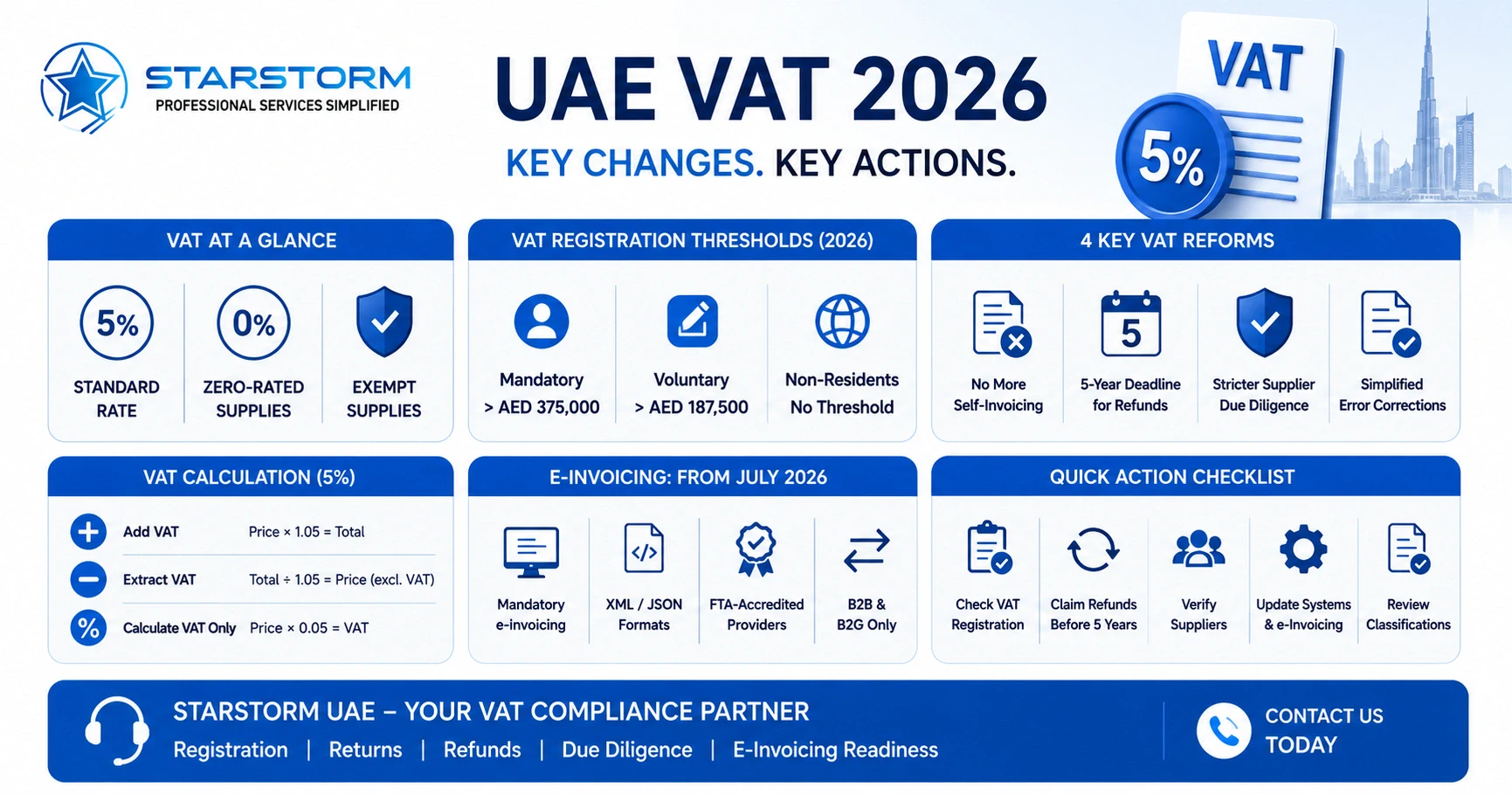
The UAE VAT rate in 2026 remains at 5% – but how you comply has fundamentally changed. From January 1, 2026, the UAE introduced major amendments under Federal Decree-Law No. (16) of 2025 that affect every VAT-registered business in the country. Whether you run a startup, an SME, or an established multinational, these reforms reshape your invoicing requirements, refund rights, and supplier responsibilities. This guide explains exactly what changed, what it means for your business, and what you must do right now to stay fully compliant.
Use the table below to check your position instantly:
| Your Situation | Action Required |
| Turnover > AED 375,000 | Mandatory VAT registration – register now |
| Turnover > AED 187,500 | Voluntary VAT registration available |
| Input VAT credits from 2021 or earlier | Claim refund immediately – 5-year deadline applies |
| Suppliers not FTA-verified | Audit your vendor base – new anti-evasion rules apply |
| Using manual invoicing | Upgrade systems before July 2026 e-invoicing mandate |
What Is VAT in the UAE and How Does It Work?
VAT – or Value Added Tax – is an indirect consumption tax applied at each stage of the supply chain. It was introduced in the UAE on January 1, 2018, as part of the country’s economic diversification strategy. Today, VAT is governed by the Federal Tax Authority (FTA) under Federal Decree-Law No. (8) of 2017, as amended by Federal Decree-Law No. (16) of 2025.
The standard UAE VAT rate is 5% on most goods and services. If you sell a product for AED 1,000, you charge the customer AED 1,050 – the AED 50 is VAT collected on behalf of the FTA.
Here is how the UAE VAT chain works:
- Output VAT – VAT you charge your customers on sales
- Input VAT – VAT you pay on your business purchases
- Net VAT – the difference you either pay to the FTA or claim back as a refund
Not every supply is taxed at 5%. Some supplies are zero-rated (VAT applies at 0% – exports, certain healthcare and education services), which allows input VAT recovery. Others are exempt (certain financial services, local passenger transport, bare land), where no VAT is charged and no input VAT can be recovered.
Getting this classification right is critical. Misclassifying supplies is one of the most common – and costly – VAT mistakes in the UAE.
What goods and services are exempt from VAT in the UAE?
The simple answer is: residential rent, bare land, local passenger transport, and most financial services are VAT-exempt. This means no VAT is charged – but no input VAT can be recovered either. Zero-rated supplies (like exports) are different: VAT applies at 0%, and input VAT recovery is still allowed.
Who Must Register for VAT in the UAE?
The simple answer is this: if your taxable supplies and imports exceed the mandatory threshold, registration is a legal requirement – not a choice.
Mandatory VAT Registration
- Annual taxable turnover exceeds AED 375,000 in the previous 12 months, or
- You expect to exceed AED 375,000 in the next 30 days
You must apply within 30 days of crossing the threshold. Late registration carries a penalty of AED 10,000.
Voluntary VAT Registration
- Available if taxable turnover or qualifying taxable expenses exceeds AED 187,500
- Allows you to reclaim input VAT on purchases before you hit the mandatory level
- Particularly useful for startups with high setup costs and low early revenue
- Voluntary registration also strengthens credibility with B2B clients and government entities
Non-Resident Businesses
Foreign businesses making taxable supplies in the UAE must register for VAT regardless of turnover. There is no threshold exemption for non-residents. If your customers are UAE-based and VAT-registered, the reverse charge mechanism may shift the reporting obligation – seek professional advice to confirm your specific situation.
Penalty Reminder: Late registration is AED 10,000. But there are additional penalties for operating without a Tax Registration Number (TRN), issuing non-compliant invoices, and filing late VAT returns (AED 1,000 for first late filing; AED 2,000 for repeat offences within 24 months).
VAT Registration Threshold UAE – 2026 Summary
| Registration Type | Threshold | Deadline to Register |
| Mandatory | AED 375,000 | Within 30 days of crossing |
| Voluntary | AED 187,500 | Anytime after crossing |
| Non-residents | No threshold | Before making taxable supplies |
What Is the VAT Rate in UAE in 2026?
The UAE VAT rate in 2026 is 5%. This is the official standard rate confirmed by the Federal Tax Authority (FTA) and the UAE Ministry of Finance. There is no change to the standard rate, zero-rated categories, or exempt supplies.
What changed is not the rate – it is the compliance rules around invoicing, refunds, supplier verification, and enforcement.
| Supply Type | VAT Rate | Input VAT Recovery |
| Standard-rated (most goods & services) | 5% | Yes |
| Zero-rated (exports, certain healthcare/education) | 0% | Yes |
| Exempt (financial services, residential rent, local transport) | Nil | No |
| Out-of-scope (outside UAE VAT framework) | N/A | No |
Is the UAE VAT rate changing in 2026? No. The official UAE VAT rate remains at 5% for 2026. There are no announced changes to the standard rate, zero-rated categories, or exempt supplies. The Federal Tax Authority has confirmed this position.
Does Dubai have a different VAT rate? No. The UAE VAT rate applies uniformly across all Emirates – including Dubai, Abu Dhabi, Sharjah, and the rest. There is no separate Dubai VAT rate. The standard rate is 5% nationwide.
How Much VAT Will You Pay? Quick VAT Calculator
Use this simple formula to calculate VAT in the UAE:
- To add VAT: Multiply your price by 1.05
- Example: AED 500 × 1.05 = AED 525 (VAT = AED 25)
- To extract VAT from a total: Divide the total by 1.05
- Example: AED 525 ÷ 1.05 = AED 500 (VAT = AED 25)
- To calculate 5% VAT only: Multiply by 0.05
- Example: AED 1,000 × 0.05 = AED 50 VAT
Quick reference table:
| Sale Price (AED) | VAT at 5% (AED) | Total inc. VAT (AED) |
| 100 | 5 | 105 |
| 500 | 25 | 525 |
| 1,000 | 50 | 1,050 |
| 5,000 | 250 | 5,250 |
| 10,000 | 500 | 10,500 |
What Changed in UAE VAT for 2026? The Four Key Reforms
Under Federal Decree-Law No. (16) of 2025, effective January 1, 2026, the UAE Ministry of Finance introduced four major amendments to the VAT law. Here is what each one means for your business.
Reform 1 – No More Self-Invoicing Under the Reverse Charge Mechanism
Previously, businesses importing goods or services under the reverse charge mechanism (RCM) had to issue a tax invoice to themselves. From January 1, 2026, this requirement is removed.
You no longer need to create a self-invoice for RCM transactions. Standard supplier invoices and valid contracts are now sufficient – as long as you retain supporting documents as required by the FTA’s Executive Regulation.
What this means for you: Less paperwork for B2B importers and service-based businesses. But you must still maintain clear audit evidence. The FTA expects complete records even without the self-invoice.
Reform 2 – Five-Year Deadline to Claim VAT Refunds
A strict five-year limit now applies to claiming excess refundable VAT balances. Once five years pass from the date the refund became due, your right to claim that refund expires permanently.
This directly affects businesses that have accumulated input VAT credits over time – particularly exporters, new businesses with high startup costs, and firms waiting on long-pending refunds.
What this means for you: Audit your VAT accounts now. Identify any outstanding refundable balances. If credits date back to 2021 or earlier, act immediately – the deadline is already close.
The VAT refund process in UAE – step by step:
- Log into the FTA e-Services portal
- Confirm your input VAT exceeds output VAT for the period
- Submit a VAT refund request with supporting documentation
- FTA reviews and approves (typically within 20 business days for straightforward claims)
- Refund is credited to your registered bank account
Remember: Under the new 2026 rules, any refund claim older than five years cannot be submitted. Act before the window closes.
Reform 3 – Stricter Supplier Due Diligence and Anti-Evasion Rules
This is the most significant enforcement change. The FTA now has the authority to deny your input VAT recovery if:
- The transaction was part of a supply chain connected to tax evasion, and
- You knew – or reasonably should have known – about the irregularity at the time of claiming
The Ministry of Finance stated clearly: businesses are required to verify the legitimacy and integrity of supplies before deducting input tax.
This places a direct compliance responsibility on your business. You can no longer rely solely on holding a valid tax invoice. You must now verify your suppliers actively.
What this means for you: Review your vendor base. Confirm all key suppliers are FTA-registered and in good standing. Document your due diligence checks. A supplier’s compliance failure can now cost you your own input VAT deductions.
VAT due diligence checklist for UAE businesses:
- Confirm supplier holds a valid TRN (Tax Registration Number)
- Verify TRN on the FTA’s official public register
- Check supplier’s compliance history where possible
- Retain all verification records in your audit file
- Repeat checks periodically – not just at onboarding
Reform 4 – Simplified Error Corrections in Past VAT Filings
The 2026 amendments make it easier for businesses to correct mistakes in previous VAT returns. This reduces the administrative burden and financial risk of historical filing errors.
What this means for you: If you have known errors in past returns – incorrect supply classifications, missed input VAT claims, or reporting inconsistencies – now is the right time to correct them under the simplified process before any FTA audit is initiated.
Coming Next: Mandatory E-Invoicing From July 2026
Beyond the Decree-Law No. (16) amendments, UAE businesses must also prepare for mandatory e-invoicing, with phased implementation beginning July 2026.
What is e-invoicing in the UAE? The simple answer is: e-invoicing (also called electronic invoicing) replaces paper and PDF invoices with structured digital formats that are transmitted directly to the FTA via accredited service providers. It is not just a digital PDF – it is a fundamentally different invoicing process.
Under this system:
- Tax invoices must be generated and transmitted in structured digital formats (XML/JSON) – not PDFs or paper
- Invoices must be exchanged via FTA-accredited service providers (ASPs) using the Peppol framework
- This applies initially to B2B and B2G (business-to-government) transactions
Key e-invoicing deadlines:
| Phase | Start Date | Who Is Affected |
| Phase 1 | July 2026 | Large businesses (to be confirmed by FTA) |
| Phase 2 | TBC | SMEs and remaining businesses |
Action required now: Review whether your current accounting or ERP software supports e-invoicing formats. If not, upgrading your system before July 2026 is critical to avoid non-compliance.
How Do VAT Returns and Refunds Work in the UAE?
Once VAT-registered, here is your core compliance cycle:
- Issue compliant tax invoices on every taxable sale – full tax invoices for B2B or supplies over AED 10,000; simplified invoices for B2C under AED 10,000
- Record all input and output VAT accurately in your accounting system
- File quarterly VAT returns via the FTA e-Services portal within 28 days of the tax period end
- Pay any net VAT due by the return deadline to avoid surcharges
- Claim refunds if input VAT exceeds output VAT – subject to the new five-year claim window
Common pain points businesses face:
- Incorrect supply classifications causing over or under-reporting of VAT
- Missing or incomplete invoices resulting in denied input VAT claims
- Cash flow pressure while waiting on VAT refund approvals
- Accounting systems not updated to reflect the 2026 reform changes
- Suppliers with compliance issues putting input VAT deductions at risk
UAE VAT penalty structure – what you need to know:
| Violation | Penalty |
| Late VAT registration | AED 10,000 |
| First late VAT return | AED 1,000 |
| Repeat late VAT return (within 24 months) | AED 2,000 |
| Operating without a TRN | Additional penalties apply |
| Issuing non-compliant invoices | Penalties apply |
What the 2026 VAT Reforms Mean for Different Business Types
Startups and SMEs
The removal of self-invoicing under the reverse charge mechanism reduces paperwork for early-stage B2B businesses. The simplified error correction process also lowers the risk of costly historical mistakes. However, the five-year refund deadline is urgent – if your business has accumulated input VAT credits, recover them before they expire. Consider voluntary VAT registration early if your setup costs are significant.
Voluntary VAT registration in UAE is particularly valuable for startups. Even before hitting the AED 375,000 mandatory threshold, registering voluntarily at AED 187,500 lets you reclaim input VAT on setup costs, tech infrastructure, and early purchases – improving cash flow from day one.
Importers, Exporters and Trade-Oriented Businesses
Zero-rating for exports remains intact – but documentation requirements are strict. You must maintain complete records: shipping documents, contracts, supplier credentials, and proof of export. The new anti-evasion rule makes supplier verification a non-negotiable compliance step. One unverified supplier could cost you thousands in denied input VAT claims.
VAT on imports in UAE – key points:
- Imports of goods are subject to VAT at the point of entry
- The reverse charge mechanism applies for imported services (no longer requires self-invoicing from January 2026)
- Full input VAT recovery is available for registered businesses on qualifying imports
- Exporters can zero-rate qualifying exports – but documentation must be airtight
Established and Multinational Companies
The 2026 reforms demand a full compliance audit. Review all outstanding refundable VAT balances and act before the five-year limit closes the window. Update your procurement and accounting workflows to reflect the new supplier verification requirements. If your business operates across multiple UAE entities or jurisdictions, ensure all subsidiary compliance processes are aligned with the updated framework.
How Starstorm UAE Can Help You Navigate VAT Compliance in 2026
VAT compliance in the UAE is no longer just a finance task – it is a core business responsibility. The 2026 reforms raise the stakes for every business that claims input VAT, deals with international suppliers, or holds refundable balances.
Here is how Starstorm UAE supports your business:
- VAT Registration – We handle your FTA registration from start to finish, ensuring your TRN is issued correctly and on time, whether mandatory or voluntary
- Supply Classification – We identify which of your supplies are standard-rated, zero-rated, or exempt, eliminating the classification errors that lead to penalties and denied refunds
- Compliant Invoicing Setup – We configure your invoicing and accounting systems to meet FTA standards – including preparation for the July 2026 e-invoicing mandate
- VAT Return Filing – We prepare and file your quarterly VAT returns accurately, so you never miss a deadline or misreport a figure
- Refund Claims – We identify recoverable VAT balances, prepare the documentation, and submit refund claims before the five-year deadline expires
- Supplier Due Diligence – We audit your vendor base to identify any compliance risks that could jeopardize your input VAT recovery under the new anti-evasion rules
- 2026 Reform Compliance Review – We conduct a full review of your VAT records, systems, and workflows to ensure complete alignment with the January 2026 changes
Need VAT services in UAE? Starstorm UAE serves businesses across Dubai, Abu Dhabi, Sharjah, and all Emirates. Our VAT specialists are FTA-aligned and experienced across all business types – from startups to established multinationals. [Contact us today for a free VAT compliance review.]
With Starstorm UAE, VAT becomes a managed, strategic part of your business – not a source of risk and stress.
Practical Steps to Take Right Now
- Confirm your VAT registration status – Are you registered? Should you be? Check against the AED 375,000 mandatory threshold and AED 187,500 voluntary threshold
- Audit your refundable VAT balances – Identify credits older than four years and submit claims before the five-year window closes
- Verify your supplier base – Confirm all key suppliers are FTA-registered and compliant; document your checks
- Update your accounting system – Ensure your software reflects the 2026 RCM changes and begin preparing for e-invoicing by July 2026
- Review your supply classifications – Check that every sale is correctly classified as standard-rated, zero-rated, or exempt
- Correct past filing errors – Use the simplified correction process now, before any FTA audit is triggered
- Partner with a VAT specialist – The 2026 reforms add complexity. Expert support saves time, reduces risk, and protects your input VAT recovery
Conclusion
VAT in the UAE is not just a regulatory checkbox. It is a financial discipline that directly impacts your cash flow, profitability, and legal standing. The 2026 reforms under Federal Decree-Law No. (16) of 2025 make compliance both simpler in some areas and more accountable in others. Simpler invoicing for reverse charge transactions, clearer refund timelines, and easier error correction are genuine improvements. But stricter supplier verification and the five-year refund deadline introduce real financial risks for businesses that are not prepared.
The UAE VAT rate in 2026 may not have changed – but your obligations have. Now is the time to audit your VAT position, verify your suppliers, claim outstanding refunds, and prepare your systems for e-invoicing. Starstorm UAE is ready to guide you through every step so that VAT becomes a tool for financial clarity, not a source of avoidable risk.
Frequently Asked Questions
1. What is the VAT rate in UAE 2026 – has it changed?
No. The UAE VAT rate in 2026 remains at 5% for standard-rated supplies. Zero-rated and exempt categories are also unchanged. What changed on January 1, 2026 are the compliance rules – specifically around invoicing, refund deadlines, supplier verification, and error corrections under Federal Decree-Law No. (16) of 2025.
2. Who must register for VAT in the UAE?
Any business with annual taxable turnover exceeding AED 375,000 must register for VAT. Voluntary registration is available from AED 187,500. Non-resident businesses making taxable supplies in the UAE must register regardless of turnover – there is no threshold exemption.
3. What is the new five-year rule for VAT refunds in UAE?
From January 1, 2026, businesses have a five-year window to claim refundable VAT balances. Once that window closes, the right to claim expires permanently. If you have input VAT credits dating from 2021 or earlier, submit your refund claim immediately.
4. What does the new supplier due diligence rule mean for my business?
Under the 2026 reforms, the FTA can deny your input VAT recovery if a transaction involved a supply chain connected to tax evasion – and if you knew or should have known about it. You must actively verify that your suppliers are FTA-registered and compliant. A valid tax invoice alone is no longer sufficient protection.
5. Are there any VAT exemptions in the UAE?
Yes. VAT-exempt supplies in the UAE include residential rent, bare land, local passenger transport, and most financial services. No VAT is charged on exempt supplies, and no input VAT can be recovered. Zero-rated supplies (such as exports and certain healthcare and education services) are different – they are taxed at 0% but input VAT recovery is still allowed.
6. What is the VAT refund process in UAE?
Log into the FTA e-Services portal, confirm your input VAT exceeds output VAT, submit a refund request with documentation, and await FTA approval (typically within 20 business days). Under the 2026 rules, the five-year deadline applies – credits older than five years cannot be claimed.
7. What is e-invoicing in the UAE and when does it start?
E-invoicing in the UAE is a mandatory digital invoicing system requiring businesses to issue tax invoices in structured XML/JSON formats via FTA-accredited service providers. It replaces paper and PDF invoices for B2B and B2G transactions. The phased rollout begins July 2026. Businesses should audit their accounting software now to ensure compatibility.
8. How do I calculate VAT in the UAE?
To add 5% VAT to a price, multiply by 1.05. To extract VAT from a VAT-inclusive total, divide by 1.05. For example: AED 1,000 × 1.05 = AED 1,050 total (AED 50 VAT). AED 1,050 ÷ 1.05 = AED 1,000 (confirming AED 50 VAT).
9. What are the VAT penalties in the UAE?
Key UAE VAT penalties include: AED 10,000 for late registration, AED 1,000 for the first late VAT return, and AED 2,000 for repeat late filings within 24 months. Additional penalties apply for operating without a TRN and issuing non-compliant invoices. Under the 2026 reforms, failure to verify suppliers can result in denied input VAT – an indirect but significant financial penalty.
10. Does voluntary VAT registration make sense for my business?
Voluntary VAT registration makes sense if your taxable turnover or qualifying expenses exceed AED 187,500 – especially if you have significant input VAT on purchases. It lets you reclaim VAT on business costs before hitting the mandatory threshold, improves cash flow, and strengthens credibility with B2B clients and government entities.
Related Posts